Understanding FA
What Is Friedreich’s Ataxia?
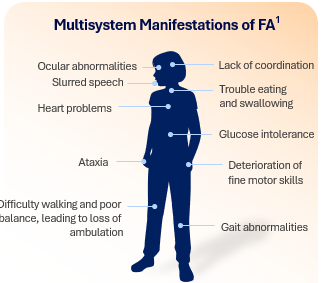
Friedreich’s ataxia (FA) is a rare inherited condition that affects multiple systems throughout the body. It primarily affects the nervous system and heart and can also affect muscles, bones and other parts of the body. Symptoms often begin in childhood or adolescence and may include challenges with balance, coordination, movement and speech, as well as changes in heart function. Symptoms and their impact can vary from person to person and progress over time.

FA at
a Glance
Males and females
are equally affected
Symptoms typically begin in childhood, adolescence or early adulthood
Most individuals with FA will require mobility assistance as the condition progresses
Impacts ~5,000 people in the U.S. and 25,000 people globally2,3
FA is caused by changes in the frataxin (FXN) gene, which result in the body making less frataxin protein than it needs. Frataxin helps cells function properly and produce energy. When there is not enough frataxin, cells can become damaged over time, affecting multiple systems throughout the body.
FA affects approximately
5,000 – 7,000
people in the US, and
15,000
in Europe1
Clinical Trial
01
SGT-212: A Phase 1b clinical trial of an investigational gene therapy treatment for FA
Active and recruiting
Location: U.S.
Patient Stories
Resources
Learn more about FA through the following organizations:
References:
- Friedreich’s Ataxia Research Alliance. FA and FARA One-Sheet. Published August 2025. https://www.curefa.org/wp-content/uploads/2025/08/FA-and-FARA.pdf.
- European Medicines Agency. Public summary of opinion on orphan designation: Omaveloxolone for treatment of Friedreich’s ataxia. https://www.ema.europa.eu/en/medicines/human/orphan-designations/eu3182037.
- Delatycki MB, Bidichandani SI. Friedreich ataxia. In: StatPearls. StatPearls Publishing; updated July 31, 2025. https://www.ncbi.nlm.nih.gov/books/NBK563199/