

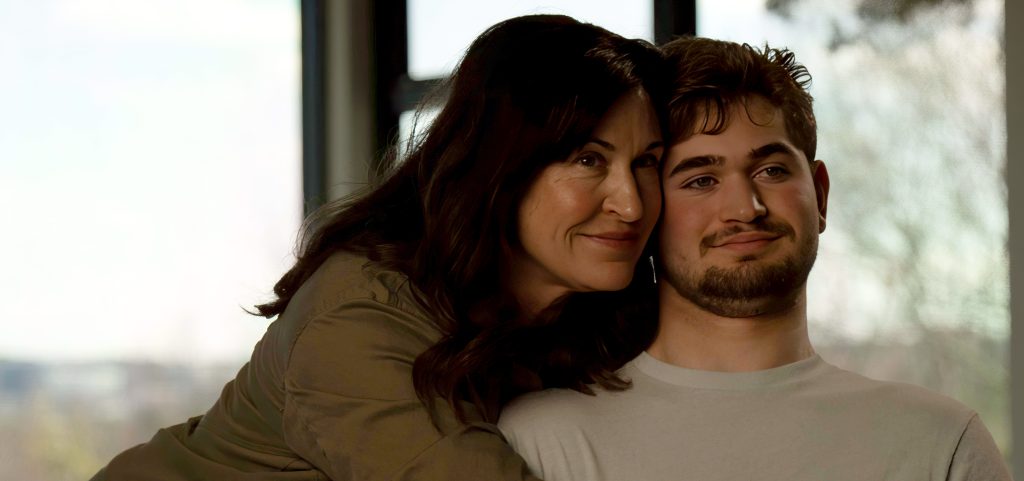

Marcy and her son Greyson, age 20, measure their lives in moments. There are difficult moments living with Greyson’s Frederich’s ataxia (FA), such as the appointments, insurance calls and sleepless nights. And then there are moments they believe matter more: friends gathered around a fire, country music playing on a cool evening or simply being together.
“Our goal as a family is to find ways to be together and provide Greyson with the best life we can,” Marcy says.

Journey to diagnosis
Marcy noticed that something was different about Greyson when he was seven years old. Though he was strong and active, she noticed he did not run as smoothly as other kids his age. His pediatrician referred the family to a neurologist, and unlike many others, his diagnosis of FA and hypertrophic cardiomyopathy came only a few months later.
Marcy recalls, “We were hearing words we had never heard before. It felt almost immediately like we were losing him. In some ways, we did.”
Life after diagnosis
For Marcy, there is a clear dividing line in the family’s story: life before Greyson’s FA diagnosis and life after it. Like any major trauma, she says, the diagnosis fundamentally changed them.
“When you find out your child has a rare, life-limiting disease that will take away his ability to hug you, walk, hear, see, speak and have an independent life, you are fundamentally changed as a parent,” says Marcy. “However, what we gained was an awareness that each moment matters and the little joys in life are actually the big ones. I remember watching Greyson run on the beach a few months after he was diagnosed and realizing what a magical thing it was to be able to move like that. Barefoot in the sand, wind in your hair, water on your toes.”
A little more than a decade later, FA now influences nearly every part of Marcy’s and Greyson’s daily life.
As Greyson’s caregiver, Marcy provides hands-on assistance with most daily living tasks throughout the day.
“Being a caregiver extends beyond the fundamentals of showering and dressing,” says Marcy.
“Caregiving is also repositioning a foot on a wheelchair footplate, tucking the back of a shirt down or helping my son recover when something as ordinary as a sneeze nearly knocks him out of his chair.”
There are at least three physical therapy appointments each week, along with additional specialist visits. The family has a wheelchair-accessible van, but even a simple trip requires additional time and planning.
At night, sleep for both Mary and Greyson is rarely uninterrupted. A ‘good’ night could be waking up once to help Greyson roll over; a ‘difficult’ night can mean waking every hour because of nerve pain, muscle pain, blankets that need adjusting or a body part that needs repositioning.
Greyson adds, “We don’t think about FA that much, but we do spend most of our time managing it.”
A life built around moments together
Greyson’s favorite thing to do is simply spending time with his friends, so his family prioritizes these gatherings. His faith is also deeply important to him, reflected in several tattoos he has chosen.
Hope for the future
As Greyson has lost much of his ability to communicate and connect with others, he often feels isolated. Looking ahead, Greyson hopes to improve his hearing and speech, gain more energy during the day, and engage in activities he enjoys.
“I want to find something to do that is enjoyable for the remaining time I have,” he says.
Marcy adds, “For those yet to be diagnosed, I hope in the future there is a treatment to prevent disease progression. For those of us who have been fighting and living with this disease for years, I hope something comes our way to make life just a little bit easier.”